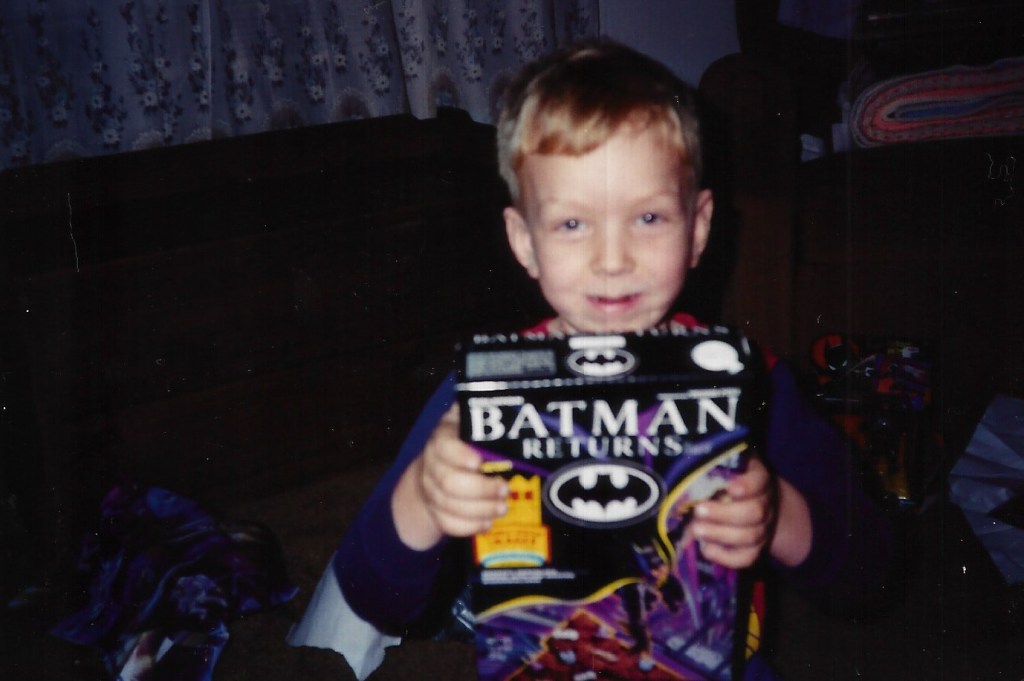
Growing up, I loved Batman.
It was my favorite toy, t-shirt and yes, sugary cereal with Bat-shaped marshmallows. When I wore the shirt, I’d tell my mom I felt like I was on his “team.” I didn’t know why at the time, but wearing it made me feel special.
In my final semester, I wrote my thesis about clothing’s impact on communication. What made me feel like a superhero had to do with Symbolic Interaction Theory. People give things meaning based on their experiences and some examples are associating a song with an ex or the dentist’s office with anxiety.
Interestingly, people adopt the traits of what they wear, like performing more attentively while wearing a lab coat or appearing more professional while wearing a suit and tie. Not that wearing a t-shirt bearing my favorite crime-fighting vigilante spurred me to run through the night chasing down bad guys, but I did feel more courageous and more eager to go on an adventure.
Association is a powerful thing. If you’re asked at the breakfast table what you want to be when you grow up and your family laughs when you tell them you want to play in the NBA, you might start to associate the act of opening up to people with dread or disappointment. Related experiences stack onto each other and become ever more rigidly associated.
That’s why it matters what words we choose when describing ourselves or what words we allow to define us. It can become a self-fulfilling prophecy, like when my mom introduced me as “the shy one” or “the baby of the family” at every turn. I started believing the hype, which seemed to close the door on me to quite a few opportunities.
When One Door Shuts, A Window Opens
Named after its creator, Joseph P. Overton, the “Overton Window” demonstrates the range of acceptable ideas in public discourse. Within the window are those ideas with the most consensus. The further out you go, the less favorable the reception until we’re outside the window.
Out there, you’ll find the more extreme proposals that have folks of varied political persuasions shaking their heads in disagreement. People use the Overton Window in conjunction with a technique known as “Door in the Face,” where someone makes a purposely unacceptable request because they want someone to reject their offer.
Yes. Someone trying to sell you on an idea makes another, more reasonable request and since it seems more appealing than the first, you’re more likely to agree. If someone’s offer is outside of your approved range, anything short of that becomes more reasonable by comparison.
How about we legalize marijuana for recreational use? No? What if we allow people to use it for specific medical conditions and otherwise punish people with a fine instead of prison? That’s how easy it is, but psychology has a few layers we can peel back and explore.
Ogres Have Layers
What do social-psychologists and Shrek have in common? They both have an affinity for onions! Yes, there is a theory of communication revolving around onions, known as Social Penetration Theory. Its chapter in my textbook opened with the scene in the orchard, where Shrek explains his similarities.
The outer layer of the onion represents superficial characteristics such as age and gender. The more layers peeled back when getting to know someone, the deeper you get into things like how they practiced their jump-shot in the backyard for hours because they aspired to be like the Michael Jordan poster in their bedroom.
At the core, you’ll find the self-concept or who someone believes themselves to be. It’s what you’d write if you turned yourself into a storybook character. Who I was and who I wanted to be was a more extensive stretch than the I-95. When I’d go out to eat with friends, the hostess would ask how big our group was. When a friend said “five,” I felt surprised that they included me. I felt invisible and not in the “what superpower would you choose” meme kind of way, so it was an unfortunately pleasant surprise when someone noticed me.
One day, it wasn’t so unfortunate.
I made a friend.
Conversations longer than one of Woody’s pull-string catchphrases in Toy Story were a precious commodity, but they weren’t with them. Everything clicked. They were a kindred spirit, and we both realized that as we shared our life stories, we were telling the same tale.
Paragraphs took the place of abbreviations as I felt free to turn more than the smallest percentage of my thoughts into text. Feeling understood allowed me to disclose an equal amount of my own life after they did the same. Answering the phone was a worrying task when I was younger, for reasons other than being confused for my stepdad, so it was incomprehensible to me for a three-hour phone call to feel so woefully incomplete.
All of this led to a series of life-changing epiphanies and changes in my neuroplasticity. For anyone who just asked, “What the fuck is that!?” the brain can re-wire itself after a series of new experiences, and that’s exactly what mine did.
I think more clearly and remember, too. Rather than asking myself where I left my wallet and telling myself, “I left it on a flat surface,” I’ll remind myself, “Oh, you left it on your dresser under a sheet of paper because you printed out a form to apply for your passport.”
Months later, the incredible amount of detail is not lost on me. January was the beginning of the end of my Bachelor’s degree. Because of that friend and the ensuing epiphanies, before the semester began, I journeyed to the 4th floor of the communications building so often the secretary felt concerned. In college, and especially at Kean University, there is a ridiculous amount of bureaucracy involved in registering for classes. Being so inspired, I had the wherewithal to withstand the bullshit.
In May, I graduated. I sat in my mom’s living room in recycled graduation garb from my community college the year before while watching Whoopi Goldberg and Cory Booker congratulate my graduating class. A month later, I checked my email and saw a reply from my current employer asking me to schedule an interview.
Two months into living at an apartment across the street from my new employer(!), I’ve noticed a series of improvements in my mental health. Moving 60 miles from where I bounced between a burden and invisible proved a blessing. I’m still a coffee fiend; I realized I drank it so often because the boost distracted me from feeling worthless.
Let me tell you a story within a story.
It’s a weeknight and I brought my report card home. Mostly Bs and Cs but one glaring F in Algebra. For dinner, we had London broil, sweet potatoes, and green beans. I remember because it’s all I could stare at while crying on my food and being berated by my mom and stepdad.
Whenever I got home from school, I went as quickly as I could to my room and closed the door. Headphones on, Foo Fighters cranked, TV on for background noise, and I was making whatever attempt I could to drown out the fact that I lived in a place where most things I did or said were ignored or mocked. MySpace, Neopets, other assorted dated references, YouTube, Facebook, Starcraft, Diablo–literally any world I could immerse myself in so that I didn’t need to exist in mine.
Why Are You So F***ing Nice!?
If I kept myself entertained, it would help, and the easiest way was humor. So, if you’ve ever wondered why I tell so many goddamn puns, there it is. I’d laugh, other people would too and for a brief moment, I could float away on the giggles. Jokes were one of the few safe things I felt free to share with other people even if they were my friends.
Another thing that helped was just being nice. I’d figuratively cross oceans if someone I cared about felt cold and bring them a coat to help make them warm because in turn, I’d feel warm too. I would feel like I had a purpose in the world. Sacrificing my time and effort for other people felt better than sitting quietly with my thoughts.
 Applied Theory
It is good to see you making content online now! Good luck with it, and keep writing when you get the chance.
LikeLiked by 1 person
Thank you, sir. I’m slowly branching out and the next step should be the merch store where I’ll sell masks with hilarious sayings on them.
LikeLiked by 1 person
Nice, I look forward to it.
LikeLiked by 1 person
Awesomeness! I’m blessed to have met & worked with Jeff. Some ppl are just genuine & it only took a convo to see that certain glow emanate from his flesh shell.
LikeLiked by 1 person
Glow emanate from my flesh shell–I’m glad the poetry didn’t stop at the 2:30 a.m. lunch breaks, brother.
LikeLike